
No, That Probably Isn't a Brown Recluse: What's Really in Your Colorado Basement
Denver Metro & the Front Range
You found a brown spider in the basement, looked it up, and now you're sure it's a brown recluse. Every picture online looks close enough.
Here's the good news, and it comes from Colorado State University: brown recluse spiders are extremely rare in Colorado. It's very likely not what you found.
Why Colorado doesn't really have brown recluses
The brown recluse is common in parts of Kansas, Missouri, Oklahoma, Arkansas and Texas. It doesn't do well here. Colorado's cold winters and dry air are the wrong conditions for it, according to CSU Extension.
CSU's records put it plainly. Only one confirmed brown recluse has ever been collected in Colorado, in Boulder County in 1996. The few others seem to have arrived by accident, carried in boxes or furniture from states where they are common. CSU notes two believable reports of recluse spiders living in basements in Pueblo and Prowers counties, and in both cases they were limited to a single building.
In other words, the brown recluse is so rare here that CSU wrote a fact sheet just because so many people think they've found one.
What you're probably looking at
CSU lists the spiders people most often mistake for a brown recluse in Colorado:
- Funnel weavers. The most common mix-up. Brown, fast, often in basements and window wells. They build a flat web with a funnel at one end.
- Wolf spiders. Larger, hairy, and they hunt on the floor instead of sitting in a web. They startle people, but CSU describes them as shy and not dangerous.
- Cellar spiders. Very long, thin legs, hanging in loose webs in basement corners.
- Woodlouse hunters. Reddish legs and body, found where pill bugs are.
The one detail that settles it: count the eyes
Most spiders have eight eyes in two rows. A recluse has six, arranged in three pairs, which is unusual among spiders. There's one pair in front and one pair on each side, forming a half circle.
People usually go by the "violin" marking on the back, but a lot of brown spiders have a dark mark there. Eye count is far more reliable. A clear phone photo zoomed in on the front of the head is often enough to check. If you can see eight eyes, it isn't a recluse.
The spider on the Front Range that does deserve respect
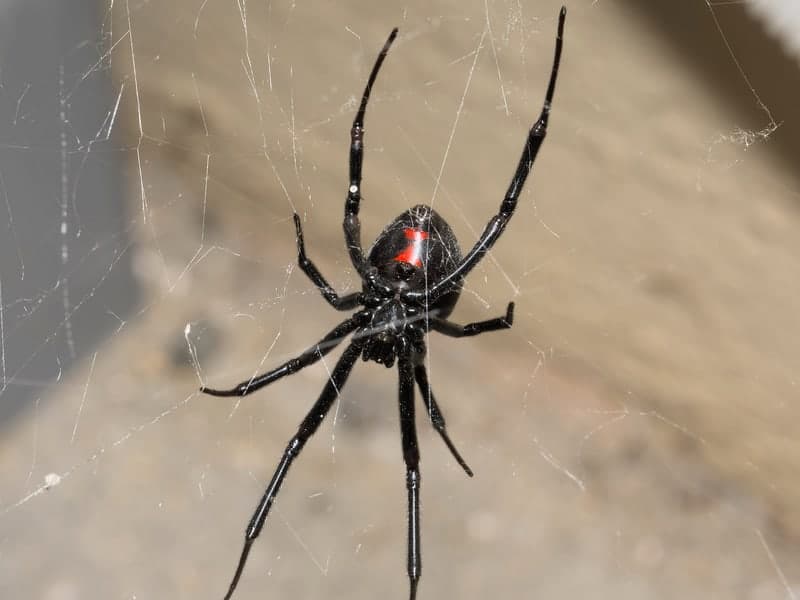
It's the western black widow, and it really does live here.
- What it looks like: a shiny black body with a red or red-orange hourglass mark on the underside.
- Where it lives: close to the ground in dark, undisturbed places. CSU lists window wells, crawl space entrances, garage corners and old rodent burrows. Add stacked boxes in basement storage, woodpiles and sheds.
- The bite: black widows aren't aggressive and bites are rare. But the venom affects the nerves, and a bite can be painful and serious.
Wear gloves before reaching into window wells, woodpiles or boxes that have sat untouched in the basement or garage. That one habit prevents most black widow bites.
"Spider bite" is often something else
Doctors and researchers have written a lot about this: many skin wounds that get blamed on spider bites turn out to be something else. CSU specifically points out that bacterial skin infections such as MRSA are among the most likely causes of sores that people blame on a recluse bite.
That matters because an infection needs different treatment than a bite. If you have a wound that's getting worse, see a doctor and don't assume it came from a spider.
What actually cuts down spiders in a Front Range home
Spiders go where their food is. A house with a lot of spiders almost always has a lot of insects too. So the fix is partly about spiders and partly about what they're eating.
- Outdoor lights. White porch and garage lights draw moths and flies at night, and spiders follow. Warm yellow "bug" bulbs attract far fewer insects.
- Window wells. Insects fall in and can't get out, which makes them a spider buffet. Clear out leaves and debris, and consider well covers.
- Basement storage. Swap cardboard boxes for plastic bins with lids, and move things off the floor.
- The outside of the house. Keep woodpiles, leaf piles and brush away from the foundation, and seal cracks and gaps around doors and vents.
How we handle spiders
- Perimeter treatment along the foundation, eaves, window wells and entry points, so spiders coming in cross it.
- Web and egg sac removal from eaves, corners and window wells, which takes care of the next generation before it hatches.
- Targeted treatment in the spots spiders like most: window wells, garage corners, woodpile areas and outdoor light fixtures.
- Treating what they eat. If flies, moths or ants are feeding the spiders, we find and treat those too.
Frequently Asked Questions
Are there brown recluse spiders in Colorado?
Extremely rarely. CSU Extension has one confirmed specimen from Colorado, and the few other reports involve spiders carried in from other states or limited to a single building.
How can I tell if a spider is a brown recluse?
Count the eyes. A recluse has six eyes in three pairs. Most spiders, including the ones people usually mistake for a recluse, have eight.
What dangerous spiders live in Colorado?
The western black widow: shiny black with a red hourglass underneath, living in window wells, garages, woodpiles and undisturbed storage. Bites are rare but can be serious.
What should I do if I think a spider bit me?
See a doctor, or call Poison Control at 1-800-222-1222. Bring the spider or a photo if you can do that safely.
Looking for more? Read about general pest control or browse the full pest library.
Free Estimate.
Tell us what you're seeing. We'll diagnose, give you a real quote, and schedule fast.