
German Roaches Don't Stay in One Apartment: How They Move Between Units in Denver Buildings
Denver, Aurora, Lakewood & the Front Range metro
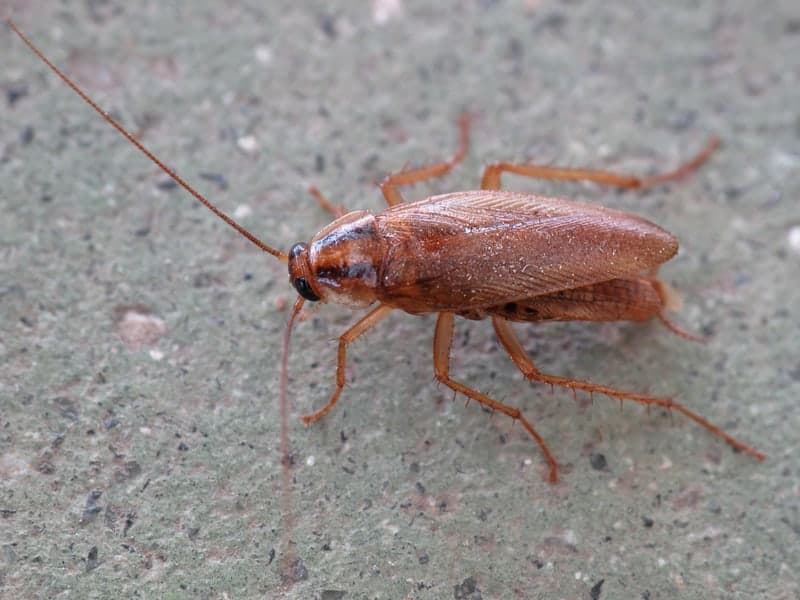
If you rent in Denver or Aurora and you saw a roach in the kitchen last night, here's the part nobody tells you: the question isn't really how one got into your unit. It's how many units in the building already have them.
German cockroaches are the most common household roach in Colorado — Denver's own public health department says so. They're small, about half an inch, light brown with two dark stripes behind the head. And in a multi-family building they behave less like an infestation in your apartment and more like an infestation in the building that happens to be visible from your apartment.
The numbers on how they spread are worse than people expect
Rutgers entomologists put monitors in all 188 units of a 13-floor apartment building and counted. At the start, 49% of the units were infested — nearly half the building.
The part that matters most to a renter: the infested units weren't scattered at random. If one apartment had roaches, the apartments next door, across the hall, and directly above and below were far more likely to have them too. The roaches were following the building's own construction — shared wall voids, and especially the vertical plumbing chases that run floor to floor. When the researchers treated the whole building instead of one unit at a time, infestation dropped from 49% to 12% in twelve months, and the side-to-side spread stopped. The up-and-down spread through the plumbing stacks was the last thing to break.
That's the real reason apartments go bad fast. It isn't that roaches sprint across a parking lot. It's that a wall cavity or a pipe chase is a hallway with no doors on it.
And they breed faster than any treatment schedule you'd guess at
A female German cockroach carries her egg case on her body until about two days before it hatches — so unlike most pests, the eggs travel with her, protected, wherever she goes. Each case holds roughly 30 to 40 eggs, and a female produces four or five of them in her life. Egg to breeding adult runs about two to three months.
Run that math across a few units and you understand why a problem that "just started" in July is a serious problem by September. By the time roaches are out where you can see them in the daytime, the population has usually outgrown its hiding spots — which means the wall voids filled up first.
Why this is a health issue and not just a gross one
Denver Public Health is blunt about it: prolonged exposure to the allergens in cockroach shed skins and droppings causes allergies and asthma, and children are the ones who get hit hardest. That's the reason a roach problem in a rental is treated as a habitability issue in Colorado rather than a housekeeping complaint.
What Colorado law actually says — if you rent
Worth knowing before you have the conversation with your property manager.
- An infestation of pests makes a rental legally uninhabitable. Colorado's habitability statute (C.R.S. 38-12-505) lists infestation of rodents, vermin, pests or insects as a condition that renders premises uninhabitable, and it requires appropriate extermination in the common areas too — not just inside individual units
- There are deadlines, and they're short. Under C.R.S. 38-12-503, once you give notice your landlord has to contact you within 24 hours. They then have 24 hours to act where the condition materially interferes with your life, health or safety, and 72 hours where the unit is uninhabitable under 38-12-505
- Denver splits the responsibility. The city's guidance puts sealing cracks and holes in walls and ceilings, sealing around electrical and plumbing penetrations, and fixing water leaks on the property manager. It puts sanitation, covered food, secured garbage, reduced clutter — and reporting the infestation promptly — on the resident
- If the manager doesn't act, Denver will inspect. Tell your property manager first, in writing. If nothing happens, file with Denver Public Health at 311, or Public Health Investigations at 720-913-1311. A confirmed violation obligates the responsible party to arrange effective treatment
- Every Denver rental needs a license. Since January 1, 2024, any residential property rented for 30 days or more in Denver has to hold a residential rental license, which requires passing a third-party inspection against the city's minimum housing standards
Practical version: put it in writing, date it, take photos, keep a copy. It costs you nothing and it starts the clock.
What that means if you own or manage the building
The same statute is the reason unit-by-unit treatment is a bad financial decision, not just a bad entomological one. If you treat 4B because 4B called, and 3B, 5B and 4A are quietly infested, you're paying for a treatment that gets re-seeded through the plumbing chase within weeks — and you'll pay again. Treating the affected unit plus the units sharing walls, the unit across the hall, and the units directly above and below is the approach with the evidence behind it, and over a year it is almost always cheaper than repeating a single-unit callback four times.
How we treat German roaches
No fogging, and no blanket spraying of your living space.
- Targeted gel bait — small placements of EPA-registered roach gel inside cracks, hinges and harborage zones. The roaches feed, return to the colony, and the colony eliminates itself. No fumes, placed where kids and pets can't reach
- Targeted granular bait — granular roach bait placed into the areas the gel can't cover: wall and cabinet voids, behind and underneath the stove, refrigerator and dishwasher, and in crawl spaces and utility chases. It reaches the harborage the roaches actually live in instead of the surfaces you can see
- Insect growth regulator (IGR) — sterilizes the breeding population so the survivors can't reproduce. Layered with the bait, because killing adults alone just makes room for the next hatch
- Crack-and-crevice dust — insecticidal dust into wall voids, behind the dishwasher, under the stove and into the pipe chases. That's the long-residual piece, and it's aimed exactly at the travel routes between units
- Sanitation walk-through — we find what's actually feeding the population. Leaking trap under the sink, grease behind the range, pet food stored open, cardboard stacked in a closet. You get a fix list, not a lecture
If you're a tenant and the building is the problem, tell us. We'll talk to the property manager or owner directly about treating the affected block of units if you'd like us to — that conversation tends to go better coming from a pest control company than from a resident.
A few things that genuinely help right now
- Fix every slow drip. German roaches will go without food far longer than they'll go without water
- Get the cardboard out of the pantry and the storage closet — corrugated is harborage, and it's how roaches arrive in the first place
- Take trash out nightly rather than leaving a bagged sack in the kitchen overnight
- Store food sealed, and clean grease off the range and hood weekly
- Foam and caulk the gaps around pipe penetrations under the sinks — that's a doorway to your neighbor
- Never bring in a used appliance, especially a microwave or a mini fridge, without checking the motor housing. That's the classic way a clean unit becomes an infested one
Frequently Asked Questions
Can cockroaches travel from one apartment to another?
Yes, and it is the normal pattern rather than the exception. A study of a 188-unit high-rise found that infested apartments were not randomly scattered: units next door, across the hallway, and directly above and below an infested unit were significantly more likely to be infested themselves. Roaches follow the building's own construction — shared wall voids and the vertical plumbing chases that run floor to floor.
Why do I have roaches when my apartment is clean?
Cleanliness controls how fast a roach population grows; it does not control whether roaches are introduced. In multi-family housing they arrive from neighboring units through wall voids and pipe penetrations, and they also ride in on cardboard boxes, grocery bags and used appliances — a secondhand microwave or mini fridge is a classic route. A spotless unit next to an infested one still gets roaches.
Will a roach fogger or bug bomb get rid of them?
No, and it usually makes the situation worse. Foggers do not reach the harborage inside wall voids, cabinet hinges and appliance motors, so instead of killing the colony they scatter it — including into the apartment next door. Researchers documented roaches moving between adjacent apartments specifically where insecticide had been applied in one unit and not in the neighboring one. Foggers also leave pesticide residue across every kitchen surface.
How fast does a German cockroach infestation grow?
Fast, because of how they breed. A female carries her egg case on her body until roughly two days before it hatches, so the eggs stay protected and travel with her. Each case holds about 30 to 40 eggs, a female produces four or five of them, and egg to breeding adult runs about two to three months. By the time roaches are visible in the open during the day, the hidden harborage is usually already full.
Is my landlord responsible for cockroaches in Colorado?
Colorado's warranty of habitability statute, C.R.S. 38-12-505, lists an infestation of rodents, vermin, pests or insects as a condition that makes a rental uninhabitable, and requires appropriate extermination in common areas as well as in units. Under C.R.S. 38-12-503, a landlord must contact the tenant within 24 hours of receiving notice, act within 24 hours where the condition materially interferes with the tenant's life, health or safety, and within 72 hours where the premises are uninhabitable. Notify your property manager in writing and keep a dated copy.
Who do I report an apartment roach infestation to in Denver?
Tell your property manager first, in writing. If they do not act, Denver Department of Public Health and Environment takes residential complaints through 311, through an online report at denvergov.org, or through Public Health Investigations at 720-913-1311. A confirmed violation obligates the responsible party to arrange effective pest control treatment.
Are cockroaches a health risk?
Yes. Denver Public Health notes that prolonged exposure to the allergens in cockroach shed skins and droppings causes allergies and asthma, and that children are the most vulnerable. Roaches also contaminate food and food-contact surfaces with bacteria picked up in drains and wall voids. That health impact is the reason an infestation is treated as a habitability issue rather than a housekeeping complaint.
Looking for more? Read about general pest control or browse the full pest library.
Free Estimate.
Tell us what you're seeing. We'll diagnose, give you a real quote, and schedule fast.